
 Dixie RelicsDixie Relics
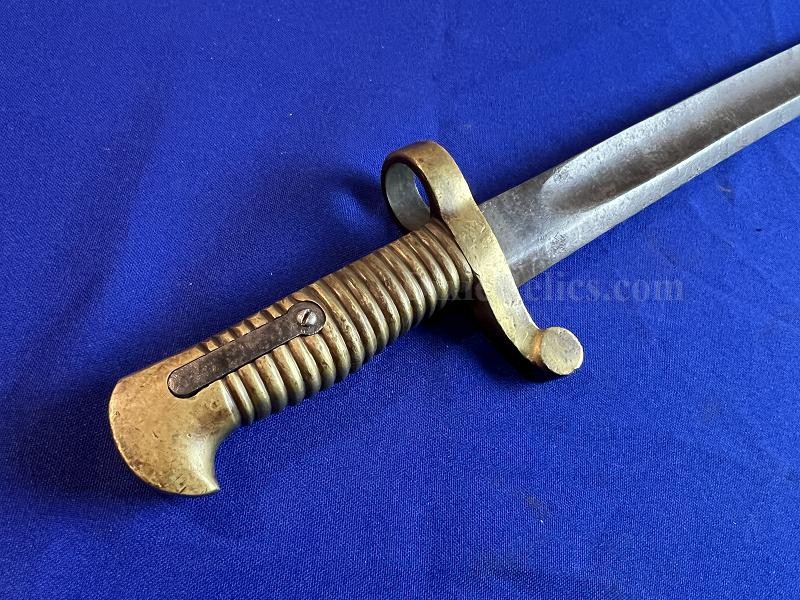
Offered here is one of those scarce PS Justice Rifle Saber Bayonets . The bayonet is serial numbered 1671 on the reverse of the muzzle ring, with the "P” prefix. Assuming the guns and bayonets were numbered in chronological order, this bayonet was produced in the early part of the Justice rifle production run. According to bayonet guru, author, researcher and collector Paul Johnson, this is a "Type III” bayonet for the Type III rifle. The "P” may indicate it was not intended to fill part of the order that went to J Henry & Son which was later. The reverse ricasso is unmarked, another indication that this may have been for one of those sub-contracted rifles. No other markings are present. The bayonet measures 26 3/8” in overall length with a 21 ¾” long semi-yataghan blade and a 4 5/8” long brass hilt. The blade has a 13 5/8” long fuller. The hilt has a 3 3/8” long guard with a .881” diameter muzzle ring and a bottom quillon that terminates in a forward-swept flat disc. The hilt is mortised for a stud that is roughly .44” wide with a .22” wide channel and a length of 1.4”. The bayonet is in about VERY GOOD+ condition, with the blade have a dull pewter patina with scattered areas of light to moderate surface discoloration, light surface oxidation and some lightly scattered pinpricking. The blade is unsharpened. The hilt has a dull golden patina and does not appear to have been cleaned recently. The blued steel latch spring is in place in the hilt and still operates correctly. History: This is a scarce example of the brass handled saber bayonet for use on a P.S. Justice rifle, as produced by that company circa 1861-1862. The firm of P.S. Justice of Philadelphia had its genesis as Justice & Steinmann, a sporting goods and hardware retailer. In 1842 Justice & Steinmann became customers of the Henry family company known as Bolton Gun Works (later J. Henry & Sons) and began retailing Henry produced rifles and shotguns in two Philadelphia retail locations. It is likely that the Justice company also offered guns by other makers as well and it appears that prior to the American Civil War, Justice was not in the business of "manufacturing” firearms. The Justice firm was one of J. Henry & Sons largest clients and purchased not only completed arms, but component parts as well. The majority of these parts were likely sold to other gun makers, but Justice may have assembled some arms from these parts in the last couple of years immediately preceding the opening of hostilities between the North and the South. It is interesting to note that the Justice firm was listed as a manufacturer of "railroad car springs” in the 1860 Philadelphia Directory, and while census data from 1860 suggests that they manufactured 2,500 guns between June 1, 1859 and June 1, 1860, author & researcher George Moller notes that the company was not considered a "manufacturer” by the US Secretary of the Interior, but only as an "assembler” . I n 1861 the firm officially changed their name to P.S. Justice, dropping the name of Steinmann who had died in 1845. Justice was definitely a shrewd businessman, who saw an opportunity to make money and managed to secure a number of US arms contracts in the early days of the Civil War. Within days of war being declared, Justice contacted his largest supplier, J. Henry & Sons, in an attempt to purchase as many arms as possible for resale to the US government and various state and local militias. He also undertook a campaign of letter writing to state and federal officials, offering to manufacture various patterns of long arms for use by the troops that were volunteering to put down the "rebellion”. In these letters he made some outrageous claims as to his manufacturing capability, suggesting that he could produce "…1,000 stands per week and increase it to double if it is possible before the autumn closes” , as well as claiming to be making "…extensive arrangements to manufacture the ‘Enfield’ pattern Rifle both short and long pattern”. Justice further claimed that that he was "…now engaged in making [a] superior Army Rifle, with either the ordinary